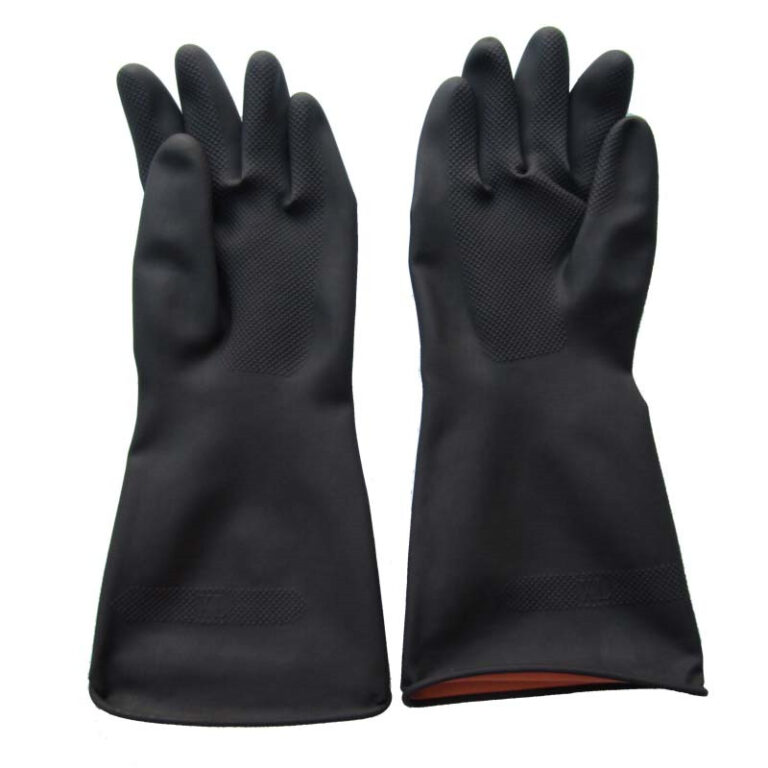
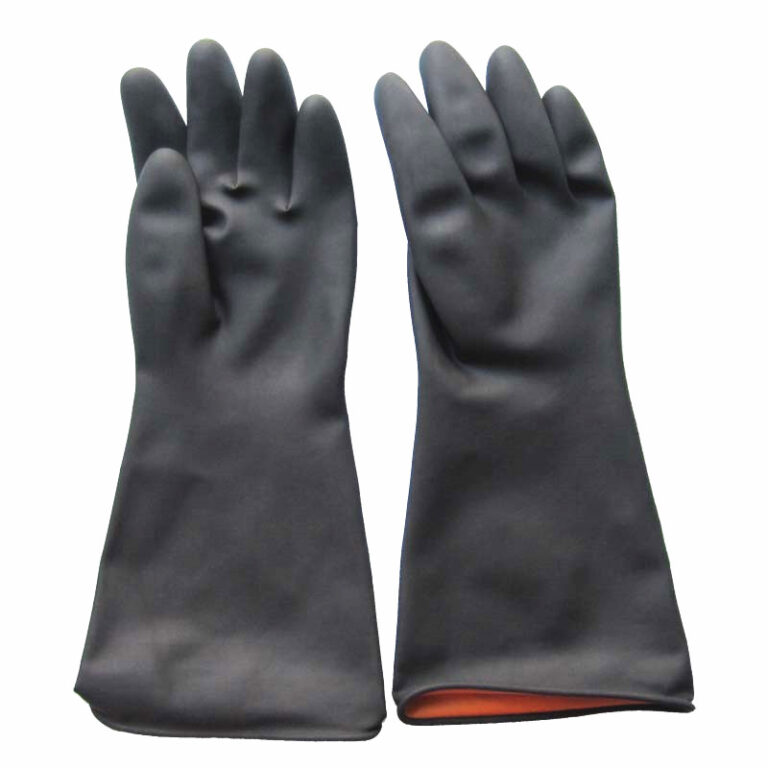
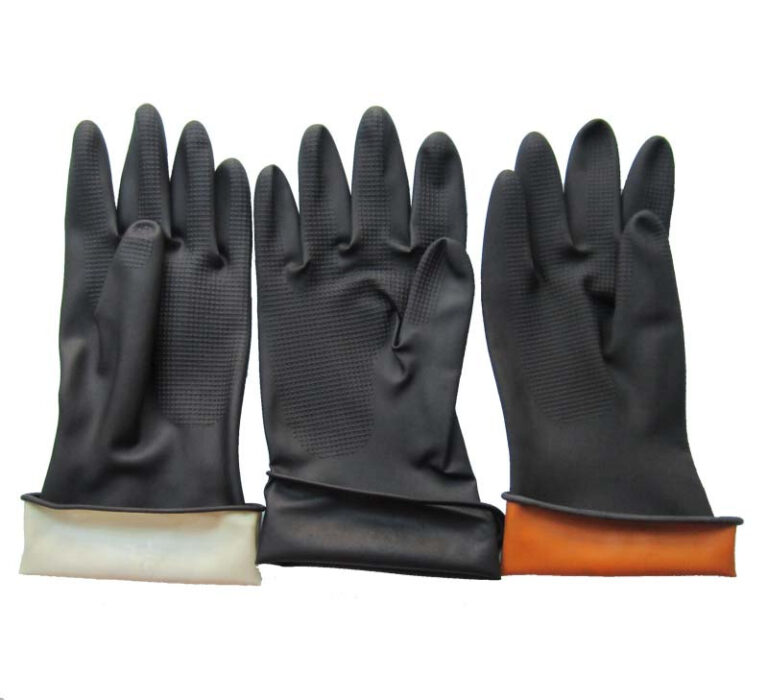
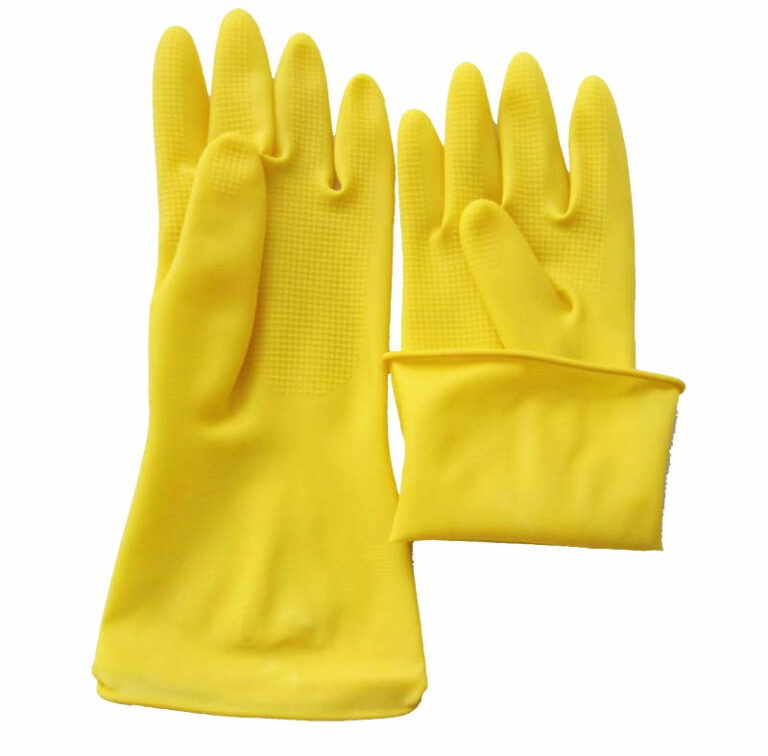
Industrial latex gloves are built for work, not for the sink. Same natural rubber, but heavier wall, longer cuff and a grip pattern that holds onto tools, bricks, wet pipes and oily parts. They are the gloves used on building sites, in workshops, in automotive bays and on loading docks.
What separates them from household gloves
Three things, and buyers should check all three:
- Weight — industrial gloves usually run 55 g to 200 g per pair. A 55 g glove is a light assembly glove; a 150 g glove is a demolition glove.
- Cuff length — typically 31 cm to 35 cm, with a straight or beaded cuff, long enough to stop debris and splashes going down the sleeve.
- Grip pattern — smooth, embossed, or diamond/bib. Diamond and bib patterns are what you want for wet or oily handling; smooth palms are for dry handling and for printing.
Choosing by task
Construction and general handling: a 31 cm diamond or embossed glove around 55–115 g covers most of it, and a black or dark colour hides dirt between washes.
Automotive and workshop: longer 35 cm cuffs with a heavier wall, so the glove survives contact with sharp edges and hot components. Oil resistance matters here — natural latex handles water-based fluids well but swells in some solvents, so tell us what chemicals are involved.
Heavy duty and demolition: 100–200 g with a reinforced palm. These are stiff, heavy gloves, and they are meant to be.
Chemical resistance is not a guess
Latex is not a universal chemical glove. It is good against water-based solutions, alcohols and many acids and bases, and poor against oils, greases and many solvents. If the task involves a specific chemical, send us the name and the concentration, and we will tell you honestly whether latex is the right material or whether nitrile is the better choice. Getting this wrong is a safety issue, not a margin issue.
Standards and documentation
Industrial gloves in Europe are usually specified against EN 388 (mechanical risk, with the four-digit performance code) or EN 374 (chemical permeation). Different markets use different schemes. Tell us the destination market and the standard your customer requires, and we will confirm what test documentation we can supply for that order before you commit.
Packing for industrial buyers
Industrial orders normally ship bulk: 12 pairs per poly bag, 120 pairs per carton, or single pairs in polybags for site issue. If your customers take gloves one pair at a time, we can supply individually bagged pairs with your label; if they are issued from a stores counter, bulk cartons are cheaper.
What we need to quote
Weight, cuff length, palm pattern, size range, colour, packing and quantity. Send those six and the quote is straightforward. Use the contact form or email us your specification sheet.
Related products