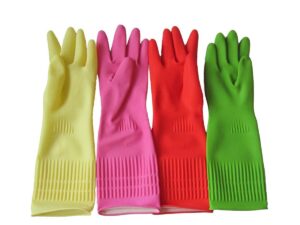

Household rubber gloves are often discarded long before the rubber has failed, and the question of whether a pair can be washed and put back to work has a plain answer: yes, within limits. A latex household glove will tolerate repeated washing in cool water with a mild detergent. What ends a glove’s working life is not the number of washes but the state of the latex film — once it has lost its elasticity or picked up a pinhole, washing the outside clean does nothing about what is now growing on the inside.
What a wash actually removes
Warm water and a little washing-up liquid lift grease, food residue and general household soil from the outer surface. A glove caked in fat loses its grip and transfers marks to everything it touches afterwards. What washing does not do is disinfect. A glove rinsed in a domestic sink comes out clean, not sterile, and the difference matters once the same pair moves from a bathroom to a kitchen.
The inside is the harder problem. Moisture that collects there — sweat, a splash over the cuff — has nowhere to go in a glove put away damp, and the warm lining becomes a workable place for bacteria and mould. Most musty-smelling gloves were not worn out. They were stored wet.
Three signs the pair has reached its end
Reuse is worth doing only while the film is intact.
- A pinhole. Water passes through, usually at a fingertip or in the webbing between two fingers, where the film is thinnest.
- Lost recovery. Stretch the palm across and let go. Latex that springs back to roughly its original width is still serviceable; latex that stays stretched has taken a permanent set and will bag and slip.
- Permanent tackiness. A surface that sticks to itself when the gloves are folded, or leaves a residue on the hands, has begun to break down.
Washing without shortening the glove’s life
Heat is the main enemy. Wash in cool or lukewarm water rather than hot, use a mild detergent rather than a harsh solvent, and keep the gloves away from bleach. Wash the outside while wearing them, rinse under running water, then remove them by hooking a finger under the cuff rather than pulling at the fingertips.
Flocked gloves benefit from an occasional wash on the inside, since the lining is what holds odour. Turn them inside out gently, rinse, and turn them back before drying; repeated turning stresses the seams at the cuff.
Drying is where most pairs are ruined
Hang the gloves by the cuff, fingers down, so water runs out, and leave them where air moves around both sides. A radiator, a sunny windowsill or a tumble dryer will age the latex faster than wearing it will. If a pair is needed quickly, push a dry cloth into each glove to draw moisture from the lining, then hang them to finish. Store a pair only when the inside is completely dry; a long shelf life counts for nothing if gloves go away damp.
Flocked and unlined gloves age differently
Household gloves are sold in two finishes, and the finish decides how a pair should be treated. Dip flocklined gloves carry a soft fibre lining that makes them easy to pull on and off, but it holds moisture for longer. Unlined gloves have a smooth interior; they dry faster, though in warm conditions the inside can stick to itself and to damp hands, which makes an unlined pair feel welded shut after a summer in a cupboard.
| Signal | What it usually means | Reasonable response |
|---|---|---|
| Damp, musty smell inside | Stored before it was fully dry | Wash, dry thoroughly, store open |
| Water beads on the outside during use | Pinhole in the film | Retire the pair |
| Palm stays stretched | The latex has lost elasticity | Retire, or demote to garden work |
A test you can run at the sink
Whether a pair is still worth keeping can be measured rather than guessed. Fill one glove about half full with water, hold it by the cuff over the sink and squeeze gently. Watch the outside, particularly at the fingertips and between the fingers: any bead of water on the dry side is a hole. Repeat on the other glove.
Two more checks take a minute. Measure the palm width with a ruler, stretch the glove to about one and a half times that width, release, and measure again — a difference of more than a few millimetres means the rubber has stopped recovering. Then weigh the pair on a kitchen scale. A household pair runs between 40 g and 92 g when new, depending on size and thickness; note that figure while the gloves are new, because a pair that has become noticeably lighter has lost material, most often at the fingertips.
When reuse stops making sense
Some jobs should not share a pair. Gloves used to clear a bathroom drain should not later handle food, and a pair worn for gardening carries soil into the lining that no rinse will remove. Colour is the simplest way to keep the roles apart, and gloves bought in S, M, L or XL let each person keep their own pair rather than one being stretched to fit everybody.
For anyone buying, the practical question is not how many washes a glove survives but whether the film is substantial enough for the work it is bought for. The household latex glove range sets out the weights and finishes used for different jobs, and the earlier note on why latex gloves discolour in storage covers the changes that washing will not reverse. With a ruler, a kitchen scale and a bowl of water, the decision to keep a pair or replace it becomes something a reader can settle at the kitchen sink rather than guess at.
Related reading
- How to Dry Rubber Gloves Properly Without Ruining Them
- Why Rubber Gloves Get Sticky Inside and How to Stop It
- Powdered vs Powder-Free Gloves: What the Powder Is For
Comparing specifications rather than brands? The household latex range lists weights and cuff lengths model by model.
The gloves described in this article
- Household latex gloves — 30–33 cm, 40–92 g per pair, flocklined or unlined
- Industrial latex gloves — 31–38 cm, 55–200 g per pair
- Extra long cuff gloves — 38 cm, 45 cm and 55 cm
Figures are the weights and lengths we run in production; the exact specification is confirmed per order.