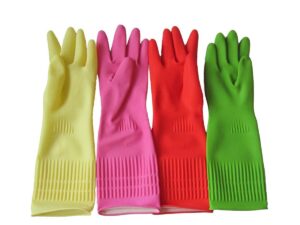

Shake a new pair of rubber gloves out of its polybag and a faint white dust sometimes puffs out of the cuff. It is not mould, it is not a defect, and on most household gloves sold today it is not there at all. Knowing which of the three inner finishes you are holding explains how a glove feels in its second hour, and why the same glove can feel slippery on one job and secure on another.
Why a glove needs something on the inside
Latex film is tacky. Two surfaces pressed together in a warm warehouse will bond, and a glove that has bonded to itself tears when pulled apart. The cuff also has to slide over a hand, often a damp one, without the film rolling up at the wrist.
Makers solve this in one of three ways: dust the inside with powder, bond cotton fibre to it, or leave the film bare. Each is a finish, decided at the factory, and it stays with the glove for life.
What the powder actually is
The powder is food-grade cornstarch, sometimes blended with a small amount of a lubricating agent; talc was used historically and has largely gone. It is applied to the inside of the cured film before the glove is stripped from its former, so it does two jobs at once: it stops the film sticking to the mould, and it gives the wearer a dry slip layer.
That is the whole function. Powder is not a coating, not a barrier and not a treatment against anything. It is a dry lubricant that happens to be edible.
Powder and flock are not the same thing
Both make a glove easier to pull on and both feel soft, which is why they get confused. Powder is loose: it sits on the surface, migrates, and can be shaken out. Flock is fixed: short cotton fibres sprayed onto the still-wet inside and bonded there. They do not come away in normal use, and they absorb sweat rather than letting it pool on the skin.
A dip-flocked glove therefore contains no loose powder at all, even though it feels softly lined. An unlined glove is bare film, and bare film clings to a dry hand.
Three ways to check a pair at home
None of these needs equipment beyond a dark surface and a damp finger.
- The dark card test. Shake the glove hard over black paper or a dark worktop. Loose starch appears at once as a pale film of dust. Flock appears as a few stray fibres, not a dust cloud. Bare film leaves nothing.
- The damp finger test. Run a wet fingertip around the inside of the cuff and rub it against the thumb. Powder turns into a smooth white paste. Flock feels like wet cotton and stays fibrous.
- The cling test. Press the cuff against itself and let go. Bare film grips and holds; powdered film slides apart.
A kitchen scale answers the other half of the question, and the table below gives the range its reading should fall in.
Where powder helps and where it does not
Powder shines in short wear: dry hands, quick changes, gloves pulled on and off between tasks. It struggles in long wear, because it absorbs sweat only until it is saturated and then becomes a paste that clumps in the palm. Grip on a wet glass or a soapy plate can fall away at exactly that point. The residue is the other cost: powder leaves a film on the hands and, in food work, on whatever the glove touches.
What flocked and unlined feel like over an hour
A flocked glove starts slightly warm and stays drier, because the fibres hold sweat away from the skin. The trade is a little less feel through the fingertips and a lining that wears thin first where friction is highest.
An unlined glove gives the closest fit and the clearest feel, and turns unpleasant fastest in heat. Both are made in the same lengths and weights, so it is the finish, not the size, that changes the experience. A flocked lining also holds water after washing and needs thorough drying, which the routine in whether household latex gloves can be washed and reused covers.
The measurements that do appear on paper
Length and weight are the two figures worth asking for, because they are the only ones routinely recorded. Finish is the third, and it is stated as a word rather than a number.
| Pattern | Length | Weight per pair |
|---|---|---|
| Household | 30–33 cm | 40–92 g |
| Extended household | 38 cm | 75–120 g |
| Long cuff | 45 cm | 140 g |
| Extra-long cuff | 55 cm | 190 g |
| Industrial | 31 ± 1 cm | 55–110 g |
| Industrial, heavier | 35–38 cm | 100–200 g |
The household latex glove range sets those figures against the three finishes side by side. A 65 g glove and a 90 g glove can carry the same lining, and a heavier glove is still the wrong choice for a hot sink. Pairs are packed one to a polybag, twelve into a clear middle bag, and ten or twenty bags to a carton — a great deal of film pressed together, which is the condition powder was invented for. Sizes run S, M, L and XL, with no larger shell beyond XL, so a hand at the top of the range is a reason to look at cuff length rather than another size up.
What you can tell before the next pair
Powder is a dry lubricant, flock is a bonded lining, and bare film is neither. Once you know which one is in your hand, the rest follows: a dust cloud over dark paper means starch, a fibrous rub means flock, and a cuff that grips itself means bare film. That is enough to judge whether the glove suits the job, and whether the next pair needs a lining at all.
Related reading
- How to Dry Rubber Gloves Properly Without Ruining Them
- Why Rubber Gloves Get Sticky Inside and How to Stop It
- Latex Glove Allergy: What Actually Causes the Reaction
Comparing specifications rather than brands? The household latex range lists weights and cuff lengths model by model.
The gloves described in this article
- Household latex gloves — 30–33 cm, 40–92 g per pair, flocklined or unlined
- Industrial latex gloves — 31–38 cm, 55–200 g per pair
- Extra long cuff gloves — 38 cm, 45 cm and 55 cm
Figures are the weights and lengths we run in production; the exact specification is confirmed per order.