Open any glove price list and the first variable is weight: 55 g, 65 g, 100 g, 130 g. It looks precise. In reality gram weight is the single most negotiated and most misreported number in the household glove trade, and understanding it will save you more money than any price discussion.
What the number refers to
Gram weight is the weight of one pair of gloves, not one glove. It is measured after curing, with the glove dry and without packing. Because a pair is two gloves and each glove is dipped individually, factories normally weigh ten or twenty pairs on a laboratory balance and divide.
Expect a tolerance. A production line dipping natural latex will not hit the same weight every cycle, so a “65 g” glove is realistically 63–67 g. Ask what tolerance the factory quotes, and put it in the purchase order. A supplier who refuses to state a tolerance is telling you something.
The bands that matter in practice
| Range | Typical use | What changes |
|---|---|---|
| 45–55 g | Light household cleaning, dishwashing, food service | Thin wall, high sensitivity, lowest cost, shortest life |
| 65–80 g | General household retail, kitchen and bathroom cleaning | The mainstream supermarket grade in most markets |
| 90–110 g | Heavy household, winter markets, reusable cleaning | Noticeably thicker wall, better abrasion life |
| 120–130 g+ | Industrial handling, long-cuff heavy duty | Reduced dexterity, maximum puncture and tear resistance |
| 55–200 g | Industrial latex, smooth or diamond grip | Weight tracks the chemical and abrasion duty, not comfort |
The relationship is not perfectly linear. Doubling gram weight from 55 g to 110 g roughly doubles wall thickness, but it does not double the number of wash cycles a glove survives — abrasion resistance improves faster than puncture resistance at the low end, and the curve flattens above about 120 g.
Where the number is stretched
Three practices are common enough that you should check every new supplier:
Weighing with powder or packing. A powdered glove carries talc inside. If the supplier weighs the glove before washing, the figure is inflated by a gram or two per pair.
Quoting the heaviest size. Gloves are weighed in size L or XL but sold in a size assortment. If your order is mostly size S, the real average weight is lower than the quoted figure.
Quoting before curing loss. Latex loses water during vulcanisation. A figure taken on the wet former is meaningless.
How to verify a shipment yourself
- Take ten pairs at random from at least three cartons.
- Remove powder or dust by rinsing and drying, or ask for powder-free samples.
- Weigh on a scale accurate to 0.1 g. Weigh pairs, not single gloves.
- Average the ten results and compare with the specification, using the agreed tolerance.
- Record the size of each pair tested — a size S pair and a size XL pair of the same nominal weight will not match.
This takes fifteen minutes and settles most disputes before they become claims.
Choosing the weight for your market
Weight is a positioning decision as much as a technical one. A 55 g glove competes on price and sells to buyers who replace gloves often. A 100 g glove supports a premium shelf position and a “heavy duty” claim, and it survives the reuse that many households actually practise.
The mistake is ordering a weight that does not match the claim on the packaging. A box that says heavy duty on a 60 g glove generates returns, and returns cost more than the grams saved.
Weight is a specification, not a claim: household gloves run from 40 to 92 g per pair, and the industrial lines from 55 to 200 g, always quoted with a stated tolerance. The household range lists the weights side by side so you can compare two options against the same retail price.
Related reading
- How to Dry Rubber Gloves Properly Without Ruining Them
- Why Rubber Gloves Get Sticky Inside and How to Stop It
- Powdered vs Powder-Free Gloves: What the Powder Is For
Comparing specifications rather than brands? The household latex range lists weights and cuff lengths model by model.
The gloves described in this article
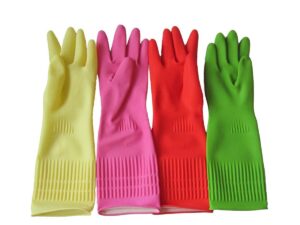
- Household latex gloves — 30–33 cm, 40–92 g per pair, flocklined or unlined
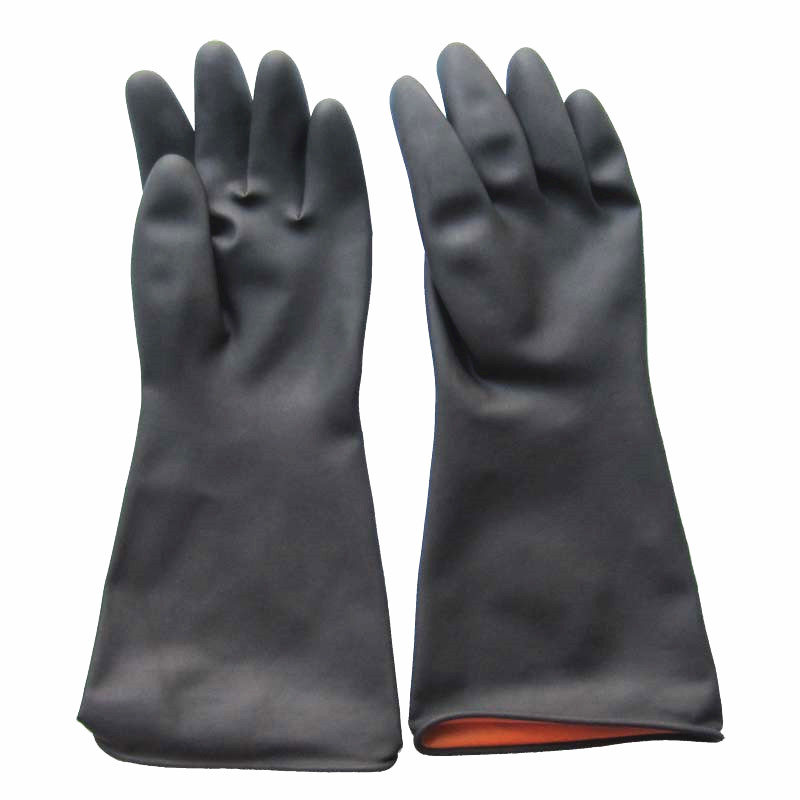
- Industrial latex gloves — 31–38 cm, 55–200 g per pair
- Extra long cuff gloves — 38 cm, 45 cm and 55 cm
Figures are the weights and lengths we run in production; the exact specification is confirmed per order.