Pull a rubber glove off after twenty minutes of washing up and the inside is warm, slick and faintly sour. Hang it up, come back the next morning, and the fingers are still tacky, sometimes worse than before. The instinct is to blame the material, but there are four separate causes, and only one means the glove is finished.
Four conditions that feel identical on a fingertip
Rubber film does not breathe. Whatever the hand gives off stays inside the cuff, and whatever was there when the glove was packed stays too. Over a few wears, four things build up, and to a finger they all read as sticky.
- Sweat and skin oils — a film of moisture and sebum that never evaporates.
- Starch residue — powder that has taken up water and turned to paste.
- Plasticiser — the oil that keeps the film soft, rising to the surface with heat and age.
- Bacterial growth — the sour smell that follows the second and third.
Telling them apart matters, because the remedy for one is the opposite of the remedy for another: air drying fixes sweat and starch, but does nothing for migrating plasticiser.
Sweat is the commonest cause, and the easiest to fix
Even light work produces several millilitres of sweat an hour inside a sealed cuff. With no lining to wick it away, that water sits against the film, mixes with skin oils and softens the surface. A dip-flocked glove copes better, because the cotton fibres hold moisture away from the skin; the inside feels damp rather than slick.
The giveaway is timing. Sweat-driven tackiness appears after wear and clears after a full dry; if the fingers are still sticky after a day in dry air, sweat is not the whole story.
Starch turns to paste, and paste turns into a habitat
Powdered and flocked gloves both hold starch somewhere. Loose starch absorbs sweat until saturated, forms a thin paste, dries into a crust and re-wets every time the glove goes back on. Flock keeps starch deeper in its fibres, where rinsing does not reach it.
Once a damp organic layer sits inside a glove, the sour smell arrives within a day or two. That smell points at storage, not at the material.
When the film itself goes tacky
Latex is kept flexible by a small amount of oil blended into the compound. Heat and time push that oil to the surface — the same effect that makes an old rubber band feel greasy. A glove kept in a hot shed, a car boot or a south-facing window will go tacky inside long before any crack or tear appears.
This kind does not wash off. It returns within minutes of drying, and it usually carries a faint solvent smell rather than a sour one. The glove has not been contaminated; its surface has changed.
A test you can run with kitchen paper and a scale
Two things from the kitchen settle the question in about five minutes. Use a glove that has already been dried, not one straight off the hand, or everything reads as water.
- The paper press. Fold a dry strip of kitchen paper, push it into one finger of the glove, press for a minute and draw it out. A translucent patch means oil or plasticiser. A damp patch that darkens the paper means water. A white smear means starch.
- The scale check. Weigh the pair to the nearest gram before and after a full day of drying. A drop of two or three grams is water leaving. If the weight barely moves and the inside is still tacky, the surface is the problem, not moisture.
- The smell check. Sour and cheesy points to bacteria in a damp lining. Sharp and solvent-like points to the film.
Drying and storing so it does not come back
Dry gloves inside out, cuff down, in moving air, out of direct sun. Hung by the fingertips, water stays trapped in the fingers; left in the sink, the pair is simply soaked. That routine is the same one behind whether household latex gloves can be washed and reused.
Storage matters as much: a sealed bag in a warm cupboard holds humidity against the film, while a pair kept loose in a cool, dark drawer stays dry far longer.
What length and weight tell you, and what they do not
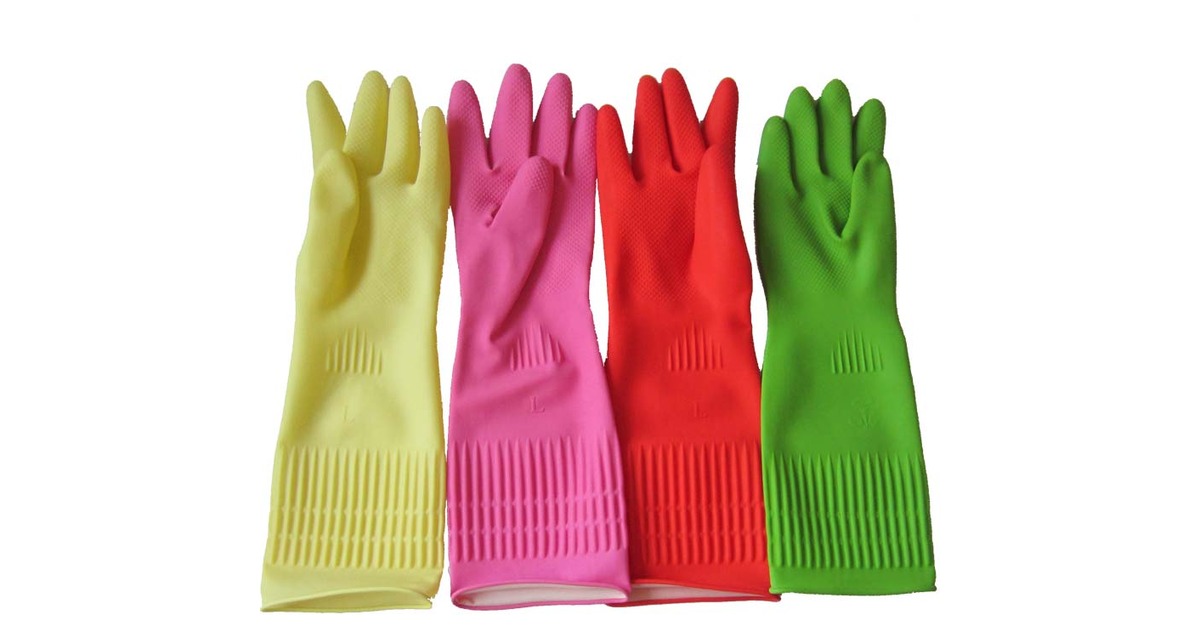
More material holds more heat, so a heavier, longer glove will run warmer inside. Household patterns run 30–33 cm at 40–92 g; the extended version 38 cm at 75–120 g; 45 cm is fixed at 140 g and 55 cm at 190 g. Industrial patterns are 31 ± 1 cm at 55–110 g, or 35–38 cm at 100–200 g. Finishes are dip-flocked, unlined, or flocked, and that word matters more than the gram figure for how wet the inside feels after an hour.
The household latex glove range sets length, weight and finish side by side for exactly this comparison. Pairs are packed one to a polybag, twelve to a clear middle bag, ten or twenty bags to a carton — and a carton in a hot container is where a lot of surface tackiness begins. Sizes run S, M, L and XL, with nothing above XL.
What you can decide from here
Stickiness inside a glove is a diagnosis rather than a verdict. Paper that comes out damp means the pair needs drying and the storage needs changing. Paper that comes out greasy means the film has aged and the pair is near the end of its life. A white smear means starch, and a different inner finish will solve it. None of those judgements needs more than a sheet of kitchen paper and a scale.
Related reading
- How to Dry Rubber Gloves Properly Without Ruining Them
- Powdered vs Powder-Free Gloves: What the Powder Is For
- Latex Glove Allergy: What Actually Causes the Reaction
Comparing specifications rather than brands? The household latex range lists weights and cuff lengths model by model.
The gloves described in this article
- Household latex gloves — 30–33 cm, 40–92 g per pair, flocklined or unlined
- Industrial latex gloves — 31–38 cm, 55–200 g per pair
- Extra long cuff gloves — 38 cm, 45 cm and 55 cm
Figures are the weights and lengths we run in production; the exact specification is confirmed per order.