
A burning or itchy feeling that appears under a rubber glove within minutes of putting it on is usually called a latex allergy, and often it is nothing of the kind. Two different reactions share that label, they are set off by different substances in the same glove, and telling them apart decides what to do next.
The word covers two separate problems
The first is immediate: itching, redness, sometimes swelling or weals, starting within minutes of contact. It is a response to the proteins in natural rubber latex.
The second is far more common and much slower. Dry, cracked, itchy skin appears hours later, often the next morning, worst where the glove grips hardest. Latex protein is not the cause. The cause is residue of the chemicals that turn liquid latex into elastic film — the accelerators left after curing.
| Question | Immediate reaction | Delayed reaction |
|---|---|---|
| Cause | Latex proteins | Accelerator residues |
| Onset | Minutes | 12 to 48 hours |
| Typical look | Raised red patch, weals, itch | Dry, scaly, cracked skin |
| Where | Anywhere the film touched | Knuckles, finger webs, wrist |
Sneezing, a runny nose, itchy eyes, wheeze or swollen lips after contact is not a skin complaint and needs medical advice rather than a different glove.
What is left in the film after curing
Natural rubber latex will not form a film alone: sulphur, zinc oxide and accelerators are added, and the coated former is heated so the chains cross-link. Some additives remain unreacted.
Thiurams and carbamates are the accelerators most often named when gloves cause skin trouble. What remains can migrate to the surface and transfer to skin, more so in warmth and sweat. A glove can be low in protein and still provoke a reaction: protein content and accelerator residue are independent measures.
Why powder made the problem worse
Powder inside a glove, usually cornstarch, helped the hand slide in and kept the film from sticking to itself. It also carried latex protein: pulled off, a glove shed powder that stayed airborne long enough to be breathed.
That is why powdered gloves fell out of favour in healthcare and food work. The powder is a carrier, not a cause: a powder-free glove removes the carrier, not the accelerators, so an accelerator problem survives the change.
A ruler, a pen and two identical tasks
It needs no equipment beyond a record.
The border. Mark the edge of any redness with a pen and measure from the cuff line to that edge with a ruler. A reaction that stops in a straight line exactly where the glove stops is almost certainly contact with something in the film. One that streaks up the forearm, or appears where the glove never reached, points to soap, detergent or something in the air.
The delay. Note the time the gloves went on and the time the itch began. Minutes point one way; a next-morning flare points the other.
One variable at a time. Wear one brand on the right hand and another on the left for the same job, changing nothing else. If one hand reacts and the other stays calm, the glove is the difference; if both react, the cause was already on both hands.
This is no substitute for patch testing, the only reliable way to name a specific accelerator, but it is the log that makes the test worth having.
What reduces exposure in daily use
Duration is the most controllable factor. A glove worn for five minutes is a different exposure from the same glove worn for two hours: warmth, sweat and friction all increase what crosses the skin.
Drying matters as much as washing. A glove turned inside out and hung up after use does not carry sweat and detergent into the next wearing; one put away damp does. The routine in whether household latex gloves can be washed and reused is a fair starting point.
A thin cotton liner puts a barrier between film and skin without changing the glove, and keeps the hand drier. Hot water and strong detergent strip the skin’s own barrier, and any glove troubles skin already cracked.
If latex really is the problem
Where protein is the cause, the film has to change. Nitrile, a synthetic rubber, contains no natural rubber protein and is the usual comparison; vinyl and polyethylene are looser, less elastic alternatives with limits of their own. Nitrile is not free of accelerators, so a change of material may solve nothing for an accelerator problem.
Where the accelerator is the cause, the answer is a glove made without it, and only the maker can confirm which chemicals were left out.
What the measurements on the box can tell you
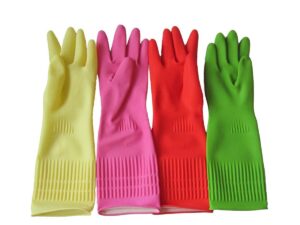
Household latex gloves run 30 to 33 cm from cuff to fingertip and weigh 40 to 92 g per pair, in a dip-flocked or unlined finish. Longer patterns are made at 38 cm and 75 to 120 g per pair, at 45 cm and 140 g, and at 55 cm and 190 g, in dipped, unlined or flocked finishes. Length is the useful figure: a 30 cm glove stops below the wrist, while a 45 cm one covers forearm skin that would otherwise meet splashes. The household latex glove range sets those lengths against finishes.
Weight and thickness describe the film, not its chemistry. Two pairs at the same weight and length can differ entirely in protein level and accelerator package, and neither appears anywhere on the glove.
What separates the two reactions is timing and border, both recordable with a pen and a ruler before the next pair goes on. A rash that starts in minutes and stops at the cuff is a different problem from one that appears next morning between the fingers, and only the second is likely to be answered by changing the material.
Related reading
- How to Dry Rubber Gloves Properly Without Ruining Them
- Why Rubber Gloves Get Sticky Inside and How to Stop It
- Powdered vs Powder-Free Gloves: What the Powder Is For
Comparing specifications rather than brands? The household latex range lists weights and cuff lengths model by model.
The gloves described in this article
- Household latex gloves — 30–33 cm, 40–92 g per pair, flocklined or unlined
- Industrial latex gloves — 31–38 cm, 55–200 g per pair
- Extra long cuff gloves — 38 cm, 45 cm and 55 cm
Figures are the weights and lengths we run in production; the exact specification is confirmed per order.