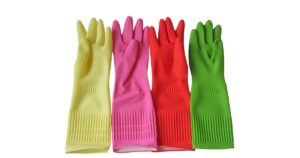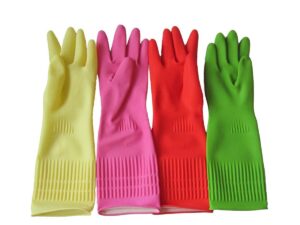

A glove that has just come out of the sink holds far more water than it looks. The film is non-porous, the cuff is a narrow opening, and the inside is lined with nothing that wicks. Water sits in the fingertips and in the rolled cuff, and it has only one way out. Getting it out without doing damage is the whole job.
Why a wet glove takes so long to dry
Water can leave a glove as liquid through the cuff, or as vapour through the film. The film is the whole point of the product — it does not pass water — so the cuff is effectively the only door, and air has to get in, pick up moisture and get out again through the same small hole. A glove lying flat on a drainer has that hole pressed shut against the steel, which is why position matters more than temperature.
Take the bulk water out first, without wringing
Hold each glove by the cuff and give it two or three sharp downward flicks. Then lay it on a dry towel, fold the towel over, and press flat with the palm. The cloth lifts the surface film in seconds, and the glove is half dry.
What not to do is wring it. Twisting loads the thinnest film — the crotch between thumb and palm, the fingertips — and leaves defects that later open into tears. A glove wrung every day for a month fails at the thumb long before an identical pair that was only pressed.
Turn it inside out, because that is where the water is
The outside dries in minutes; the inside is the surface that was against skin, and the surface with no airflow. Inverting the glove exposes it directly to moving air and shortens drying more than any other single step. Do it by rolling the cuff back over itself rather than pulling on one finger, since a pull lands on the weakest point. Storing one inside out for weeks is different: dust settles and flocked fibres mat down.
Hang it cuff down first, then flip it
The direction of hanging is a trade-off, and most advice ignores the cost of one side. Held at the fingertips with the cuff at the bottom, liquid water runs down and drips out — exactly what is wanted in the first hour. But a wet glove is heavy, and hanging it from the fingertips puts that weight on the thinnest film there is.
A workable sequence: drain it cuff down over a bowl until it stops dripping, then peg it across the cuff band with the fingers pointing down. The weight now hangs from the thickest part, and the open mouth sits at the top, where moist air can rise out of it instead of being trapped behind a fold.
Moving air beats warm air
The instinct is to drape wet gloves over a radiator. It works, and it is the fastest way to shorten a glove’s life. Heat softens the film and drives plasticiser to the surface. A glove dried that way comes out faintly tacky, then cracks at the flex points within weeks.
A draught does the same job without the damage. An open window, a doorway with cross-flow or a fan on its lowest setting dries a glove faster than a warm still room, because the rate depends on how quickly saturated air is replaced, not on how hot it is. Warm is not the same as dry. An oven or a hot hair dryer distorts a glove before it dries it.
Flocked, unlined and long gloves behave differently
An unlined glove sheds water quickly: the inside is smooth film, and a towel press removes nearly all of it. A dip-flocked glove holds water in cotton fibres that behave like a sponge and give it up slowly, so it needs longer on the line and benefits more from airflow than from warmth. The finish named on the label — dip-flocked, unlined or flocked — predicts drying time better than the gram figure.
Length matters as much. Household patterns run 30–33 cm at 40–92 g; the extended version 38 cm at 75–120 g; 45 cm is fixed at 140 g and 55 cm at 190 g. Industrial patterns run 31 ± 1 cm at 55–110 g, or 35–38 cm at 100–200 g. A 55 cm glove holds twice the water of a short pair and is awkward to invert — roll the cuff back to the wrist so the widest part can breathe.
Two checks that tell you it is actually dry
Feeling the outside tells you nothing; it dries first. Both of these look inside.
- The window test. Hold the glove against a bright window, fingers toward the light. Trapped water shows as a darker band in the fingertips and along the seam lines; a dry glove looks evenly translucent, with no dark pools at the ends.
- The tissue test. Push a dry piece of kitchen paper into one fingertip, leave it ten minutes, then pull it out. Still crisp means that finger is dry. Limp, or cool to the touch, means moisture is still leaving the film — give it a few more hours. Test the thumb last; it dries slowest.
Run that test before the glove goes into a drawer, not after. A pair stored even slightly damp goes sour within days, which is the mechanism behind why rubber gloves get sticky inside.
What you can judge from here
Drying decides how long a pair lasts, and almost all the damage done during it is avoidable: heat, twisting, and putting a damp glove away. A towel, a draught and one sheet of kitchen paper will tell you whether a glove is genuinely dry, whether it was dried too hot, and whether the pair is worth keeping — and the lengths, weights and finishes in the household latex glove range explain why two pairs on the same line can dry at different speeds.
Related reading
- Why Rubber Gloves Get Sticky Inside and How to Stop It
- Powdered vs Powder-Free Gloves: What the Powder Is For
- Latex Glove Allergy: What Actually Causes the Reaction
Comparing specifications rather than brands? The household latex range lists weights and cuff lengths model by model.
The gloves described in this article
- Household latex gloves — 30–33 cm, 40–92 g per pair, flocklined or unlined
- Industrial latex gloves — 31–38 cm, 55–200 g per pair
- Extra long cuff gloves — 38 cm, 45 cm and 55 cm
Figures are the weights and lengths we run in production; the exact specification is confirmed per order.