Every glove importer eventually asks the same question, and the answer changes the entire economics of an order: how many pairs fit in one 20-foot container? Get it wrong and you either pay for air inside the box or leave stock behind.
The container, precisely
A standard 20GP has roughly 33 m³ of internal volume and about 28 tonnes of payload. Gloves are light and bulky, so a glove shipment is almost always volume-limited, not weight-limited. You will run out of space long before you run out of payload allowance.
Useful approximations for a 20GP: internal length about 5.9 m, width 2.35 m, height 2.39 m. Usable volume after pallets and door clearance is realistically 26–28 m³ floor-loaded, less if you palletise.
The calculation
Three numbers decide everything, and your supplier has all three:
- Carton dimensions in centimetres
- Pairs per carton
- Gross weight per carton
The method:
Carton volume (m³) = L × W × H ÷ 1,000,000
Cartons per container = usable volume ÷ carton volume
Pairs per container = cartons × pairs per carton
A worked example
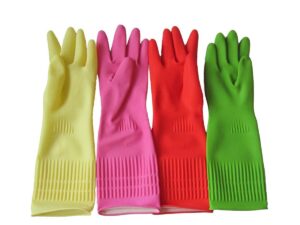
Take a common 33 cm household latex glove, 65 g, packed 12 pairs per polybag, 10 polybags per carton — 120 pairs per carton — in a carton measuring 58 × 38 × 34 cm.
- Carton volume: 0.58 × 0.38 × 0.34 = 0.0749 m³
- Cartons in 27 m³ of usable space: 27 ÷ 0.0749 ≈ 360 cartons
- Pairs: 360 × 120 = 43,200 pairs
- Weight check: 120 pairs × 65 g = 7.8 kg of gloves, plus roughly 0.8 kg of carton ≈ 8.6 kg gross. 360 cartons × 8.6 kg ≈ 3.1 tonnes — nowhere near the payload limit, which confirms the shipment is volume-bound.
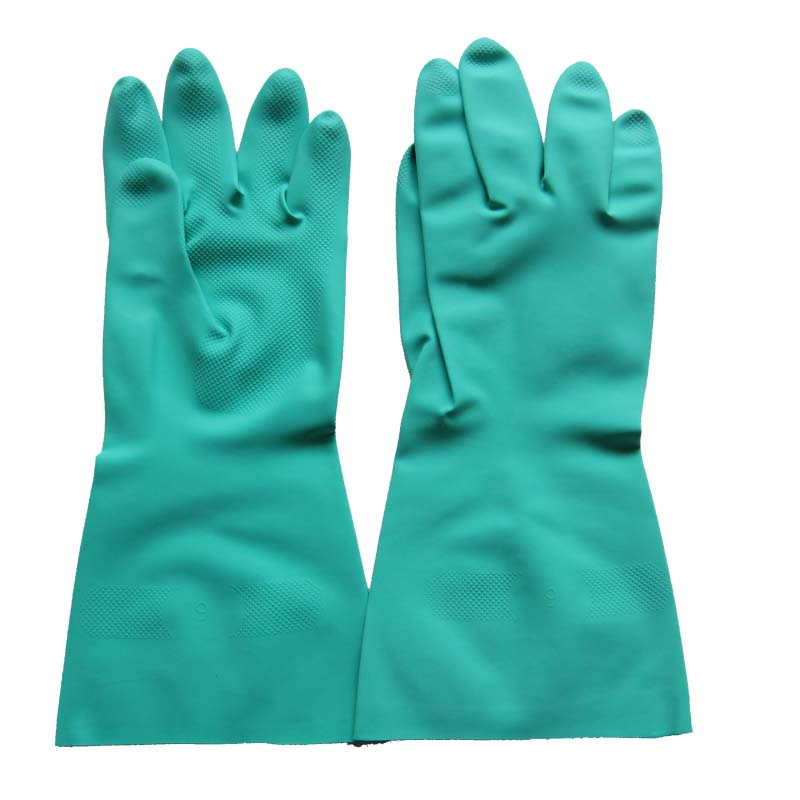
Change one variable and the answer moves a lot. A 55 cm long-cuff glove needs a longer carton; a 200 g industrial glove needs fewer pairs per carton to stay under 20 kg gross. Both cut the pairs per container, sometimes by a third.
Floor-loaded or palletised
Floor loading uses the container almost completely. Palletising costs you roughly 10–15 per cent of the volume to pallet height and gaps, but it cuts unloading time at destination and reduces carton damage. For household gloves in printed cartons, most importers floor-load and accept the handling cost.
Mixed containers
If you buy several specifications, a mixed container is often the practical answer for a first order: three or four SKUs, each below its own minimum, sharing one container. The constraint becomes carton dimension compatibility — mixing a 60 cm carton with a 34 cm carton wastes space in the stack.
What to ask before you commit to a quantity
- Carton dimensions and gross weight, confirmed in writing
- Pairs per carton at the specification you are ordering, not a generic figure
- Whether the carton is printed or plain, since printing changes nothing dimensionally but changes the minimum order
- Loading plan, if you are mixing SKUs
A supplier who can answer these three questions in one email is a supplier who knows their own packing line. That is a better signal than any certificate.
Carton dimensions, pairs per carton and a loading plan are the three numbers that decide your landed cost. Get them in writing before the deposit, not with the shipping documents. The household and industrial ranges list packing as standard.
Related reading
- How to Dry Rubber Gloves Properly Without Ruining Them
- Why Rubber Gloves Get Sticky Inside and How to Stop It
- Powdered vs Powder-Free Gloves: What the Powder Is For
Comparing specifications rather than brands? The household latex range lists weights and cuff lengths model by model.
The gloves described in this article
- Household latex gloves — 30–33 cm, 40–92 g per pair, flocklined or unlined
- Industrial latex gloves — 31–38 cm, 55–200 g per pair
- Extra long cuff gloves — 38 cm, 45 cm and 55 cm
Figures are the weights and lengths we run in production; the exact specification is confirmed per order.