If you buy protective gloves for the European market, two standards appear on almost every technical sheet: EN 388 and EN 374. They answer completely different questions, and a glove can hold one without the other. Getting the distinction right decides whether your shipment clears customs and whether your customer’s safety officer accepts it.
EN 388: mechanical risk
EN 388 covers protection against mechanical hazards — abrasion, cutting, tearing and puncture. The current version, EN 388:2016+A1:2018, is shown as a shield pictogram followed by four or five numbers and sometimes a letter.
| Position | Property | Scale |
|---|---|---|
| 1st digit | Abrasion resistance | 1–4 (4 is best) |
| 2nd digit | Cut resistance, coupe test | 1–5 (5 is best) |
| 3rd digit | Tear resistance | 1–4 |
| 4th digit | Puncture resistance | 1–4 |
| Letter | Cut resistance by ISO 13997 (TDM test) | A–F (F is best) |
| Letter P | Impact protection on the back of the hand | Present or absent |
For unsupported dipped gloves — household latex and industrial rubber — the useful signal is usually abrasion and tear, not cut. A thick 130 g latex glove typically reaches abrasion level 2 or 3. Cut levels on soft latex are low by nature, which is why cut-resistant work calls for a different product family entirely.
EN 374: chemical and micro-organism risk
EN 374 is the chemical protection family. It is now published in parts, and the one buyers meet most is EN ISO 374-1:2016+A1:2018, which defines performance requirements for chemical risks and classifies gloves into three types:
- Type A — tested against at least 6 chemicals from the standard list of 18
- Type B — at least 3 chemicals
- Type C — at least 1 chemical
Each tested chemical gets a code letter, and the glove is marked with the letter and the breakthrough time achieved. A marking such as “EN ISO 374-1 Type B, KLT” means three specific chemicals, each with a measured breakthrough time above the minimum threshold. It does not mean the glove is resistant to every chemical in the list.
Related parts cover penetration (EN ISO 374-2, the air and water leak test), degradation (EN ISO 374-4), and micro-organisms (EN ISO 374-5), which distinguishes bacteria and fungi from viruses.
The mistake that costs money
The common error is a household glove sold with a chemical-resistance claim and no test report behind it. If a glove is marketed for handling acids, alkalis or solvents, it sits in PPE Category III under EU Regulation 2016/425 and needs a notified-body examination, not a self-declaration. Ask for the certificate number and the notified body that issued it. A four-digit number alone, without a body name, tells you nothing.
What to request from a supplier
- The test report, not the logo — with the notified body name and certificate number
- The exact standard version and year, because EN 388:2003 and EN 388:2016 are not the same test
- Which chemicals were tested, with breakthrough times, if any chemical claim is made
- Whether the marking appears on the glove or only on the packaging — EU rules require both
For household cleaning gloves used with detergent and water, EN 388 abrasion and tear data usually matters more than chemical permeation data. For industrial gloves sold into plating, degreasing or solvent handling, EN ISO 374-1 is the standard your customer will ask about.
Match the standard to the exposure, and match the claim to the standard. Latex gloves for household cleaning sit outside both chemical standards, because detergent and water are not a chemical hazard in the sense EN 374 means. Where the work involves solvents, acids or concentrated chemicals, the permeation data has to come from the buyer’s market and the standard that market applies. The industrial range sets out weights, lengths and finishes; it does not claim chemical protection.
Related reading
- How to Dry Rubber Gloves Properly Without Ruining Them
- Why Rubber Gloves Get Sticky Inside and How to Stop It
- Powdered vs Powder-Free Gloves: What the Powder Is For
Comparing specifications rather than brands? The household latex range lists weights and cuff lengths model by model.
The gloves described in this article
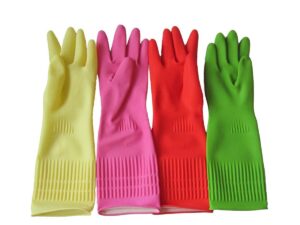
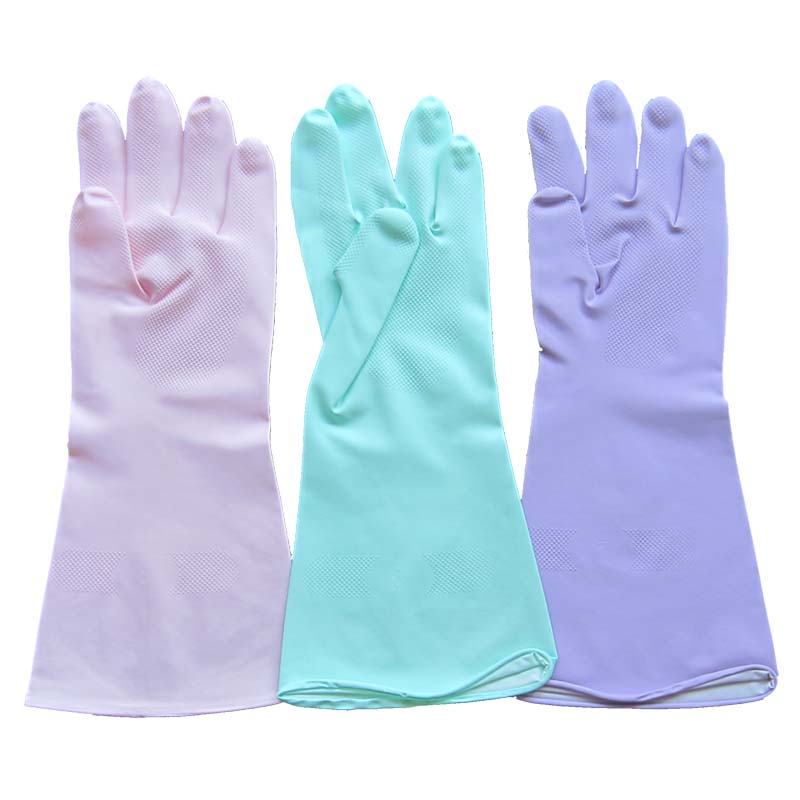
- Household latex gloves — 30–33 cm, 40–92 g per pair, flocklined or unlined
- Industrial latex gloves — 31–38 cm, 55–200 g per pair
- Extra long cuff gloves — 38 cm, 45 cm and 55 cm
Figures are the weights and lengths we run in production; the exact specification is confirmed per order.