Most first-time glove buyers lose money not on the price per pair but on the terms around it: an MOQ that forces excess stock, a sample that does not match production, a payment structure with no leverage. This is a plain walk-through of the commercial mechanics.
Minimum order quantity
MOQ in this industry is driven by the production line, not by negotiation style. Three things set it:
- Colour and compound changes. Every colour change means cleaning the dipping line. A factory will not stop a line for 500 pairs of a custom shade.
- Carton printing. Plain cartons have a low minimum. Printed cartons with your artwork have a plate or digital setup cost and typically a much higher minimum.
- Container economics. The real floor is often one 20GP, or a share of one in a mixed container.
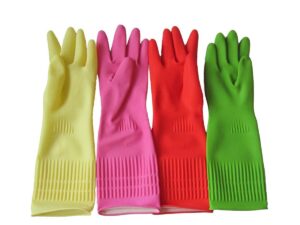
Practical range for household latex gloves is usually several thousand pairs per specification, and higher for custom colour or printed packaging. Ask for the MOQ per specification, not per order — the distinction matters when you plan a mixed container.
Samples
Expect stock samples to be free or near-free, with you paying the courier. Custom samples — your colour, your weight, your logo — are normally charged, and the charge is often credited against the order.
Two rules worth following. First, insist the sample comes from a production run, not from a laboratory hand-dip. Second, keep the approved sample sealed and signed; it is the reference for any quality dispute later. A supplier who resists a sealed counter-sample is a supplier to walk away from.
Payment terms
The standard structure is a deposit before production and the balance against the bill of lading copy — commonly 30/70, sometimes 20/80 for established customers. Alternatives:
- L/C at sight — protects both sides on large orders, but adds bank costs and documentation work
- Escrow or platform trade assurance — useful for a first order with a new supplier, adds a fee
- Full payment in advance — only defensible for very small sample-level orders
Never pay a deposit to a personal account. Payment should go to the company account named on the contract and the invoice, and the name should match the beneficiary on the certificate of origin.
Incoterms and freight
FOB is the default for container orders: the supplier delivers to the port and clears export, you control the freight. CIF suits buyers without a freight forwarder, but you lose visibility on cost. EXW is rarely worth it for a first order because you inherit the inland haulage and export paperwork.
Gloves are light and bulky, so you are buying cubic metres more than tonnes. Compare freight quotes per container, not per kilogram.
Lead time
Production for a standard specification typically runs a few weeks from deposit and artwork approval, plus transit. Two things extend it: Chinese New Year, when factories close for two to four weeks and freight rates spike before and after, and custom packaging, which adds proofing time. Plan orders around the holiday rather than discovering it in January.
Quality control
Ask what AQL level the factory inspects to and whether they will accept a third-party inspection at your cost. A supplier confident in their line will agree without hesitation. Ask also for the retained sample policy — if a defect appears three months later, can the batch be identified?
Customs classification
Household and industrial dipped gloves normally fall under HS 4015.19 for rubber, or 3926.20 for plastics such as nitrile. Rates and documentation requirements differ by destination, so confirm the code with your customs broker before you fix the landed cost calculation.
Red flags worth taking seriously
- A price far below every other quotation for the same gram weight
- Unwillingness to state a weight tolerance or an AQL level
- Requests to pay into a personal account or a third-party name
- Certificates shown as images with no certificate number or issuing body
- A website with no factory address and no production photographs
None of these is proof of a bad supplier. Together they describe a supplier you should visit, or sample twice, before wiring a deposit.
Ask for the MOQ, the sample lead time and the payment terms in one message. A supplier who answers all three without a follow-up email has a working process; everything after that is negotiation. The household and industrial ranges show how the specification side is normally written.
Related reading
- How to Dry Rubber Gloves Properly Without Ruining Them
- Why Rubber Gloves Get Sticky Inside and How to Stop It
- Powdered vs Powder-Free Gloves: What the Powder Is For
Comparing specifications rather than brands? The household latex range lists weights and cuff lengths model by model.
The gloves described in this article
- Household latex gloves — 30–33 cm, 40–92 g per pair, flocklined or unlined
- Industrial latex gloves — 31–38 cm, 55–200 g per pair
- Extra long cuff gloves — 38 cm, 45 cm and 55 cm
Figures are the weights and lengths we run in production; the exact specification is confirmed per order.