Even the most expensive glove in the world isn’t the right glove for every job.
I have run a glove factory in Foshan, China, for 23 years.
We have made both materials in the same plant for most of that time, so I have no dog in this fight.
But the honest answer is:
Latex has a few natural health advantages, and one well-known risk that’s far more misunderstood than people think.
Where latex genuinely wins
It breathes.
It’s an organic material, and it behaves like one.
Wear both materials for a 10-hour shift and your hands tell you the difference around hour six: less trapped sweat, less of that shriveled “just got out of the pool” skin, less itch.
It moves with your hand.
Natural latex is much more elastic and tends to conform to the hand more naturally.
Sounds trivial until you’re the one doing fine work all day — lab techs, dentists, QA inspectors.
Touch passes through better.
Latex drapes over your skin like a second skin, which is why phlebotomists and surgeons still reach for it when they actually need to feel what they’re doing.
And it biodegrades.
A latex glove breaks down in months under the right conditions.
Nitrile is petroleum plastic — it’ll outlive your grandkids.
Not a health benefit for your hands, but it counts for something.
The elephant in the room: latex allergy
Real. I won’t pretend otherwise.
But not every reaction to a latex glove is a latex allergy.
Three different things get lumped together:
1. Sweat rash.
Any occlusive glove seals moisture against your skin — latex, nitrile, vinyl, doesn’t matter.
The wrinkling, the redness at your wrist, the itch? Often just trapped sweat.
Change gloves more often and it disappears.
2. Accelerator allergy (Type IV).
A reaction to the chemical accelerators used to cure gloves — thiurams, carbamates, that family.
Here’s the kicker: many nitrile gloves use the same classes of accelerators.
I’ve seen buyers switch to nitrile over a “latex allergy” and the rash comes right back.
Because it was never about the latex.
3. True latex protein allergy (Type I).
The genuine article — a real reaction to the proteins in natural rubber.
Rare, can be serious, occasionally shows up as full-blown anaphylaxis.
If this is you, your doctor has already told you: nitrile, always. Don’t gamble.
Now, the part worth knowing.
During the huge expansion of latex glove use in healthcare in the 1980s and 1990s, powdered, higher-protein gloves were widely used.
The powder carried protein into the air, healthcare workers breathed it for eight hours a day, and allergy rates spiked.
That’s where latex’s bad reputation was born — earned by bad gloves, not by the material itself.
But modern latex is a different product. At least if you’re buying it from a factory like mine that actually tests what they make.
When nitrile is simply the right answer
– You’re handling oil, grease, solvents, or industrial chemicals. Latex swells and degrades; nitrile shrugs it off.
– Automotive, machining, chemical processing, heavy-duty cleaning.
– You need puncture resistance — nitrile film is tougher.
– Anyone with confirmed Type I latex allergy.
Bottom line
Food handling, medical exams, lab work, fine assembly, long shifts → low-protein, powder-free latex.
Oils, solvents, industrial chemicals, or a real protein allergy → nitrile.
The wholesale switch to nitrile made sense for hospitals full of hypersensitive patients.
For everyone else it became an overcorrection — a lot of buyers are paying nitrile prices for a material they never actually needed.
Tell me your industry, or what your hands are actually touching every day, and I’ll tell you which one I’d put on the line.
Remember, a glove is a tool.
You don’t choose a screwdriver because it’s more expensive than a wrench.

The gloves described in this article
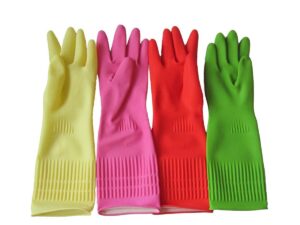
- Household latex gloves — 30–33 cm, 40–92 g per pair, flocklined or unlined
- Industrial latex gloves — 31–38 cm, 55–200 g per pair
- Extra long cuff gloves — 38 cm, 45 cm and 55 cm
Figures are the weights and lengths we run in production; the exact specification is confirmed per order.