Almost every glove inquiry we get starts with the same question: latex or nitrile? The two materials look similar on a shelf and are priced differently, but they behave very differently in use. This page is the comparison we would give a buyer over the phone, without the sales language.
What the two materials actually are
Latex gloves are made from natural rubber latex tapped from rubber trees. The material is elastic, stretches to several times its length, and contains natural proteins that a small share of people react to.
Nitrile gloves are made from a synthetic rubber (NBR) built from acrylonitrile and butadiene. There are no natural rubber proteins, the film resists oil and solvent, and it costs more per pair to produce.
Side by side
| Property | Natural rubber latex | Nitrile |
|---|---|---|
| Stretch and fit | Excellent, conforms to the hand | Good, slightly stiffer at the same thickness |
| Oil and grease | Swells and softens | Resistant |
| Puncture and tear | High tear strength | Good, better against sharp chemical contact |
| Latex allergy | Possible | No natural rubber protein |
| Grip when wet | Very good | Good, better when textured |
| Feel and dexterity | Soft, warm | Cooler, more precise at thin gauges |
| Cost per pair | Lower | Higher |
| Best for | Household, kitchen, cleaning, general wet work | Food service, automotive, chemical, tattoo and beauty, allergy-sensitive markets |
Where latex wins
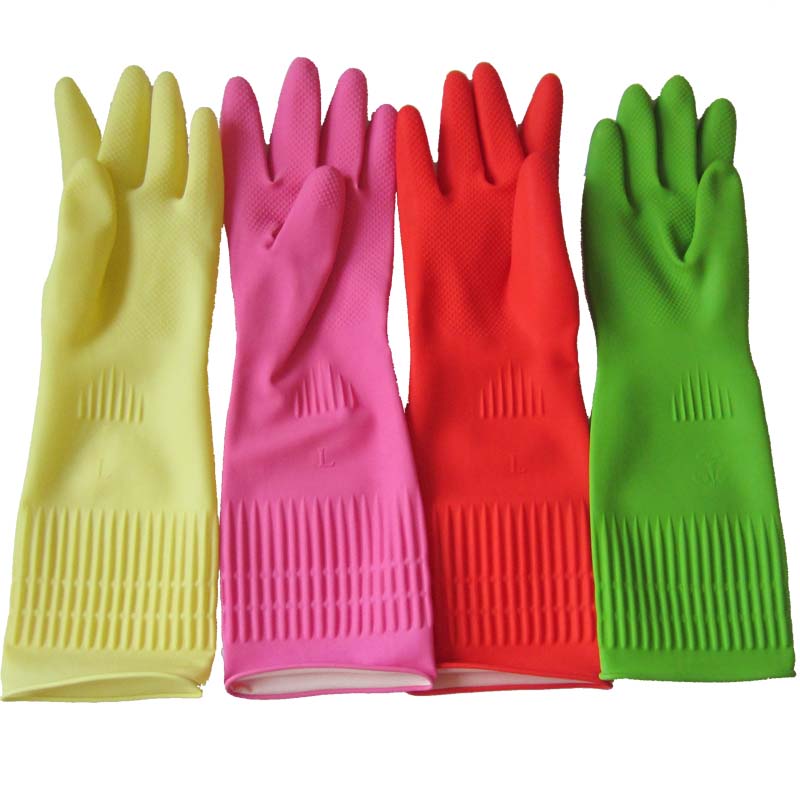
For household and kitchen gloves, latex is hard to beat. It stretches over the hand without feeling tight, it grips a wet glass better than nitrile at the same price, and it is cheaper. A 65 g latex household glove will outsell a nitrile glove of the same thickness in most price-sensitive markets, because the customer can feel the difference in fit immediately.
Latex also tolerates repeated washing and drying better. A flocklined latex glove worn for dishwashing three times a day will usually outlast a thin nitrile glove doing the same job.
Where nitrile wins
Anywhere oil is involved. Mineral oil, grease, diesel and most solvents soften natural rubber within an hour; the glove goes tacky, stretches, and tears at the thumb crotch. Nitrile does not. For a mechanic, a lube bay or a parts-washing station, the more expensive glove is the cheaper one because it survives the shift.
Nitrile also wins wherever a latex allergy is a real objection: food service, healthcare, childcare, beauty. If your market has customers who ask “is this latex-free?” at the shelf, you need a nitrile line.
The allergy question, honestly
Latex allergy affects a small percentage of the population but it is a serious issue for those who have it. If you sell into healthcare, food service or childcare in Europe or North America, expect the question. The usual commercial answer is to carry both materials and label clearly, rather than to drop latex entirely.
Price: why nitrile costs more
Nitrile raw material is a petrochemical product and costs more than natural rubber latex. Nitrile also needs a longer cure and more careful control of film thickness. The gap narrows at heavy gauges and widens at thin disposable gauges, where nitrile competes with vinyl rather than latex.
Can you ship both in one container?
Yes, and most of our distributors do. A mixed container of latex household gloves plus nitrile industrial gloves lets a wholesaler serve both ends of the market without two suppliers, two shipping bookings and two sets of documents. The only constraint is the MOQ per model, which is lower on mixed orders than most buyers expect.
A simple decision rule
- Wet household work, price-sensitive market → latex
- Oil, grease, solvent, workshop → nitrile
- Food handling with an allergy claim → nitrile
- Long cuff, heavy duty, immersion → latex, heavier gauge
- Retail range that must cover everything → both, side by side
Choose by the exposure rather than the material name: water and detergent for household work, oil and grease for industrial handling. The household latex range covers the first case, with weights from 40 to 92 g; the industrial range covers the second, from 55 to 200 g.
Related reading
- How to Dry Rubber Gloves Properly Without Ruining Them
- Why Rubber Gloves Get Sticky Inside and How to Stop It
- Powdered vs Powder-Free Gloves: What the Powder Is For
Comparing specifications rather than brands? The household latex range lists weights and cuff lengths model by model.
The gloves described in this article
- Household latex gloves — 30–33 cm, 40–92 g per pair, flocklined or unlined
- Industrial latex gloves — 31–38 cm, 55–200 g per pair
- Extra long cuff gloves — 38 cm, 45 cm and 55 cm
Figures are the weights and lengths we run in production; the exact specification is confirmed per order.