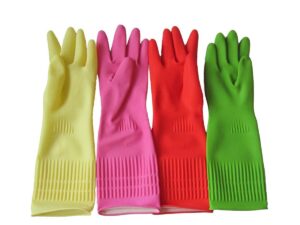
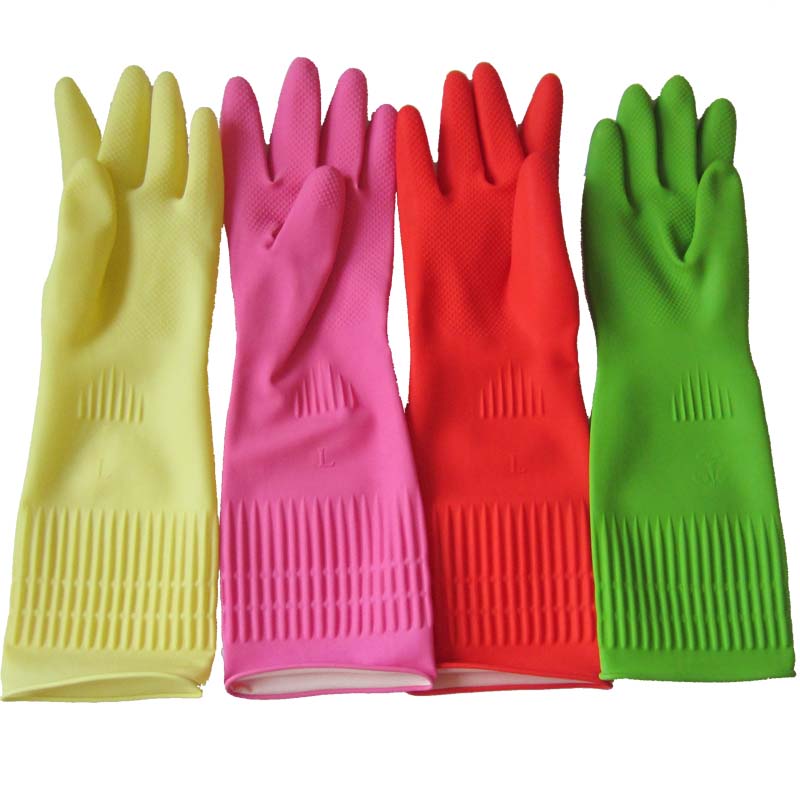
You do not need a laboratory to judge a glove sample. You need ten minutes, a ruler, a kitchen scale, a pair of calipers if you have them, and a willingness to write the numbers down. These are the same checks we run on incoming material.
Before you start
Ask the supplier for the specification first: length, weight at a named size, palm and cuff thickness, and the acceptable defect rate. Without that, you can describe a glove but you cannot judge whether it meets a promise. If the sheet is unclear, read how to read a glove spec sheet.
Test 1: the air test (2 minutes)
Hold the glove by the cuff and spin it to trap air, or blow into it like a balloon and pinch the cuff closed. Submerge it in water, or hold it against a window.
- Pass: the glove inflates and holds shape for 30 seconds with no bubbles and no slow deflation.
- Check the fingers and the thumb crotch — that is where pinholes concentrate.
- Repeat on three pairs from different bags. One pinhole in three pairs is a batch problem, not bad luck.
Test 2: the stretch test (2 minutes)
Grip the cuff in one hand and the palm in the other, and pull steadily to about twice the resting length. Then let go.
- Pass: the film stretches smoothly, goes slightly pale, and returns close to its original length.
- Fail: it tears, or it stays stretched and wrinkled. Stretched-and-stayed means undercured or aged rubber.
- Also test the cuff: stretch the beaded edge sideways. A thin bead tears here, and that is the failure your customer will report.
Test 3: thickness (2 minutes)
With calipers, measure single-wall thickness at three points: the centre of the palm, the middle finger, and 1 cm below the cuff bead. If you have no calipers, fold the film and compare the fold against a known thickness, or simply compare two samples by feel — a difference you can feel is a real difference.
Write the numbers down. A cuff thinner than about 0.10 mm is going to tear, no matter how good the palm feels.
Test 4: weight (2 minutes)
Weigh a single glove on a kitchen scale that reads to 1 g, then double it for the pair weight. Compare with the specification — and check which size the specification refers to. A 65 g claim measured on a size S is not the same product as 65 g on a size L. See what gram weight really means.
Test 5: measurement (2 minutes)
Lay the glove flat, smooth it out without stretching, and measure from the tip of the middle finger to the edge of the cuff. Compare with the stated length and tolerance, for example 31 ± 1 cm.
Then check hand fit: the glove should go on without a fight and leave the fingertips in contact with the end of the glove, with no more than a few millimetres of slack. A glove that is short in the finger is a size problem, even if the label says the right size.
What to write down
| Check | Record | Red flag |
|---|---|---|
| Air test | Pairs tested / pairs failed | Any pinhole |
| Stretch | Returns / tears / stays stretched | Tears or stays stretched |
| Palm thickness | mm, three points | Under 0.10 mm at the cuff |
| Pair weight | g, with size noted | More than 5% below spec |
| Length | cm, flat | Outside the stated tolerance |
| Visual | Bubbles, grit, colour streaks, uneven bead | Visible pinholes or a wavy bead |
The visual check people skip
Hold the glove up to a window. Look for small dark specks (grit from a dirty former), pale streaks (uneven coagulant), bubbles (air in the latex), and a wavy or thin bead. None of these show up in a photo, and all of them predict a complaint.
Compare, do not just inspect
The most useful thing you can do with two samples is put them side by side: your current supplier’s glove and the new one. Weigh both, measure both, stretch both. Differences you can see and feel will be differences your customer sees too.
Keep the numbers on paper. A sample without a recorded weight, length and cuff measurement is just a glove; the same sample with numbers beside it becomes a reference you can hold a future delivery against. For the numbers themselves, see how to read a glove specification sheet.
Related reading
- How to Dry Rubber Gloves Properly Without Ruining Them
- Why Rubber Gloves Get Sticky Inside and How to Stop It
- Powdered vs Powder-Free Gloves: What the Powder Is For
Comparing specifications rather than brands? The household latex range lists weights and cuff lengths model by model.
The gloves described in this article
- Household latex gloves — 30–33 cm, 40–92 g per pair, flocklined or unlined
- Industrial latex gloves — 31–38 cm, 55–200 g per pair
- Extra long cuff gloves — 38 cm, 45 cm and 55 cm
Figures are the weights and lengths we run in production; the exact specification is confirmed per order.