A glove specification sheet looks like a short document. In practice, half the lines decide how the glove performs and the other half decide what it costs. Buyers who cannot tell them apart end up negotiating on the wrong number.
Here is how to read one, line by line.
1. Material and compound
Natural rubber latex, nitrile (NBR), vinyl (PVC) or blends. This is the first line for a reason: it sets oil resistance, elasticity, allergy profile and a large part of the price. A “latex” glove is not automatically the same as another “latex” glove — compound formulation affects softness, colour and ageing.
2. Length
Measured from the tip of the middle finger to the edge of the cuff, laid flat and unstretched. Household gloves run 30–33 cm, professional cleaning 38–45 cm, immersion work 50–60 cm. A tolerance is normally stated, for example 31 ± 1 cm. That tolerance is not a typo: latex shrinks during cure, and a stated band lets you check the carton against the label.
3. Weight
Usually grams per pair, sometimes per piece. It is the easiest number to check and the easiest to fudge, because weight varies with size. A supplier quoting “65 g” without saying which size is quoting the small. Always ask for the weight at size L, or for a range across sizes.
4. Thickness
Millimetres, measured at the palm and at the cuff, single wall. Palm thickness drives puncture resistance and feel; cuff thickness drives tear resistance when the glove is pulled off. Thin at the cuff is where cheap gloves fail first.
5. Sizes and sizing tolerance
Hand circumference in millimetres, mapped to S/M/L/XL. A spec sheet should say which size scale it uses, because Asian, European and US scales do not align exactly. See our size chart for the conversion.
6. Surface finish
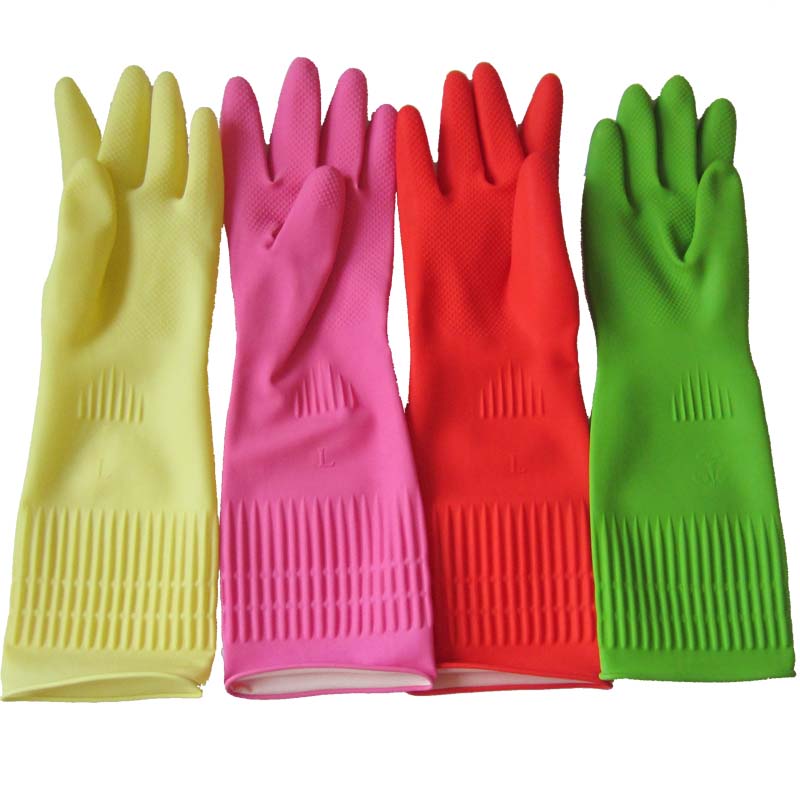
Smooth, embossed, diamond, crinkle or sand patch. The finish is not decoration: it decides grip when wet, and it decides whether the glove marks a polished surface. Inspection lines and paint shops specify smooth for exactly that reason.
7. Cuff type
Beaded (rolled edge, resists tearing when pulled), straight (cheaper, tears more easily), pinked (zigzag cut, decorative). Also check whether the cuff is reinforced, which matters on heavy industrial gloves.
8. Colour and colour tolerance
Either a named colour or a Pantone reference. Ask for the tolerance: two batches of “yellow” can differ enough to be visible side by side on a shelf. A supplier who matches to an approved sample before bulk production is telling you they have done this before.
9. Packing
Pairs per polybag, bags per carton, carton dimensions and gross weight. This line decides your freight cost per pair more than the glove price does. A carton that is 2 cm too tall on a pallet can cost you a layer of cargo.
10. Test and acceptance criteria
Pinhole test method (air inflation or water), sampling plan, acceptable defect rate, tensile strength and elongation. If a spec sheet has no acceptance criteria, it is a description, not a specification.
Which numbers actually move the price
| Line | Price impact |
|---|---|
| Weight and thickness | High — the single biggest driver |
| Material | High — nitrile above latex, vinyl below |
| Length | Medium — more material, more cure time |
| Lining | Medium |
| Surface finish | Low to medium |
| Colour | Low, unless a custom Pantone match is required |
| Packing | Low per pair, high per carton and per container |
The three questions to ask before you sign
- At which size is the stated weight measured?
- What is the acceptable defect rate, and how is it checked?
- Which numbers are guaranteed in the contract, and which are “typical”?
A specification is only useful if it can be checked. If a number cannot be measured on a sample, it will not be measured on a delivery either. The industrial range shows typical specifications written that way, and how to check a glove sample shows how to verify them in ten minutes.
Related reading
- How to Dry Rubber Gloves Properly Without Ruining Them
- Why Rubber Gloves Get Sticky Inside and How to Stop It
- Powdered vs Powder-Free Gloves: What the Powder Is For
Comparing specifications rather than brands? The household latex range lists weights and cuff lengths model by model.
The gloves described in this article
- Household latex gloves — 30–33 cm, 40–92 g per pair, flocklined or unlined
- Industrial latex gloves — 31–38 cm, 55–200 g per pair
- Extra long cuff gloves — 38 cm, 45 cm and 55 cm
Figures are the weights and lengths we run in production; the exact specification is confirmed per order.